At some point between 1390 and 1400 Ulrich Trainer (1355 – 1412) married Anna von Nothafft, zu Hetzkauen (Nothafft von Hetzkoven) Wernberg (1365 – 1426). Anna was the daughter of Johann IV. Nothafft von Wernberg whose life is documented from 1366 to 1390 and Praxedis von Ehrenfels.
Most of the family’s history is recorded after the 14th century, whereas “our” Anna precedes this date. Also, because Johann IV, produced only daughters, he is frequently overlooked among the genealogies, whereas his younger brother Albrecht (ca 1332-1380) who started a male line is not. As a result most discussion of this family involves Albrecht and his descendants.
Anna Nothaft’s marriage to Ulrich Trainer was her second marriage; she had previously been married into the von Murach family. The marriage of Anna and Ulrich is documented by a settlement of 1408, in which Ulrich Trainer appears as a cousin by marriage of Friedrich Auer von Prennberg. Anna and Ulrich had a son, Erasmus Trainer, who served on Regensburg’s council from 1431 until his death in 1481. He repeatedly held the office of city chamberlain and was Hansgraf in 1441 and 1445. Erasmus’s son Hans Trainer later served as Hansgraf in 1486–87. See the article by Herbert R. Lemmel HERE.
The article also identifies Anna’s uncle Heinrich Nothaft as a mayor of Regensburg, married to Ursula von Haydau. It cites the Bavarian State Archives reference BayHStA, Notthafft Lit. 1458, p. 8 for the Johann Nothaft–Praxedis von Ehrenfels marriage.
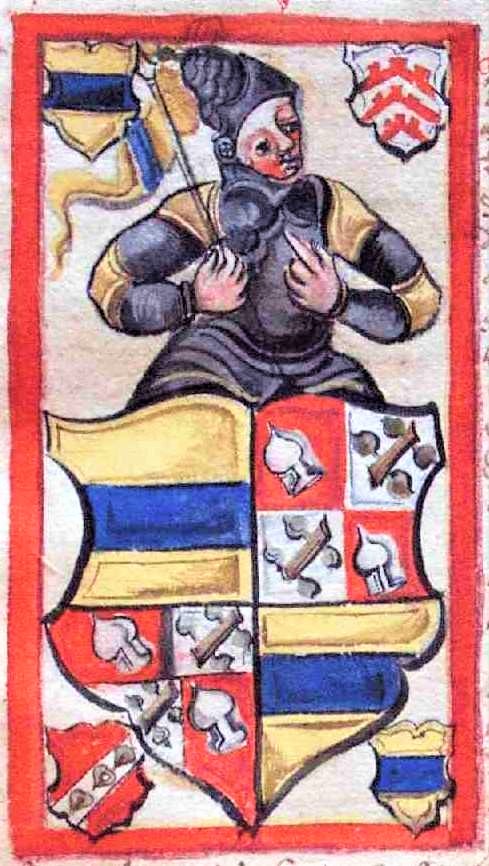
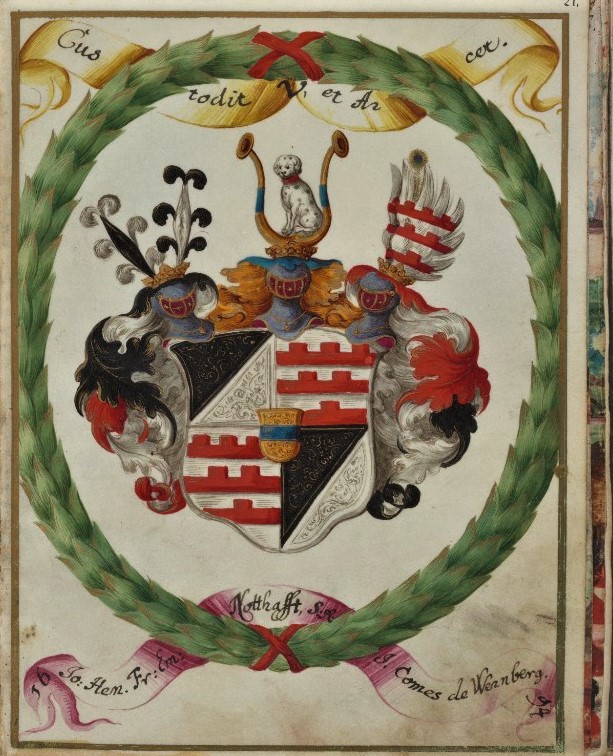
The Nothaft family adopted a distinctive shield consisting of a blue bar between two gold bars which can often be used to identify the family among genealogies. The conventional heraldic description is “Or, a fess Azure”—a gold shield bearing one blue horizontal band—rather than three separate bars.
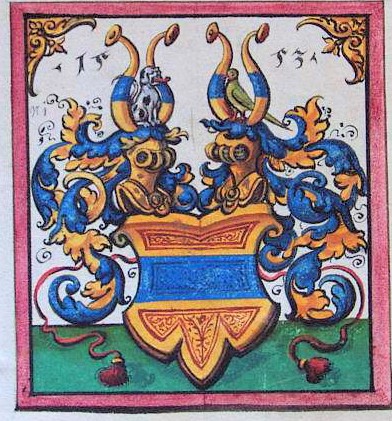
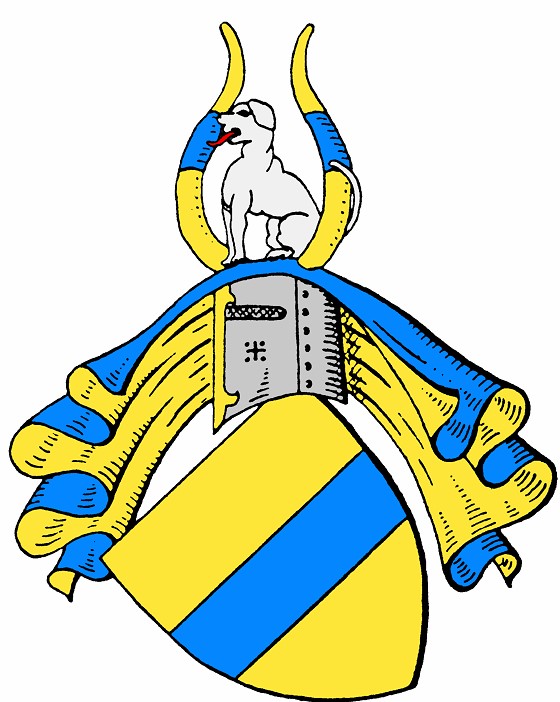
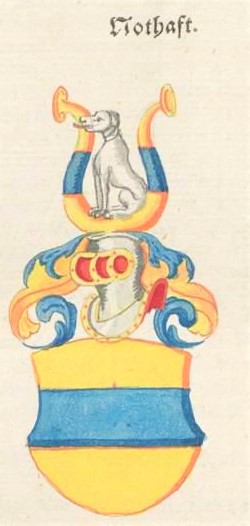
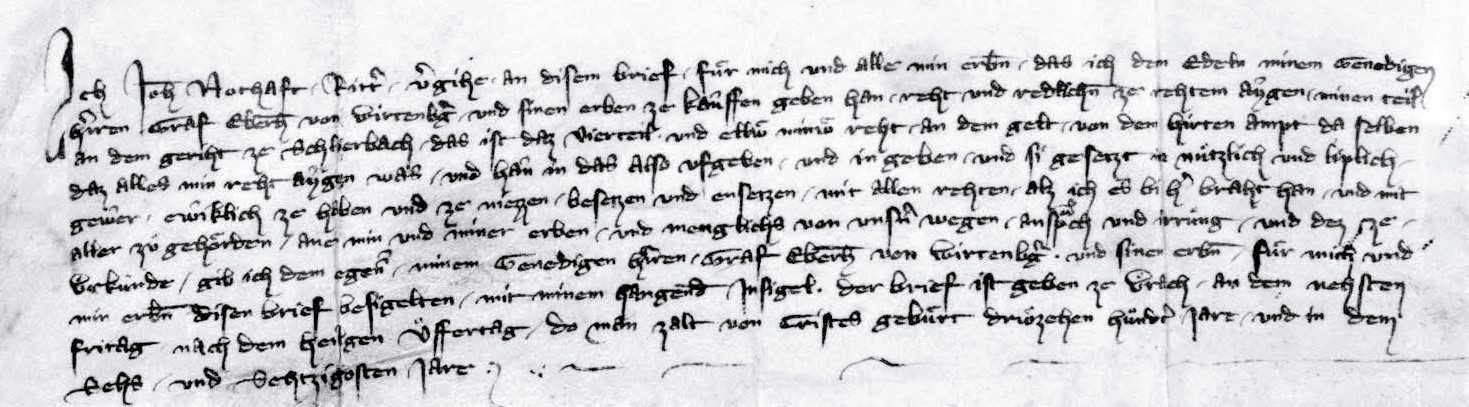
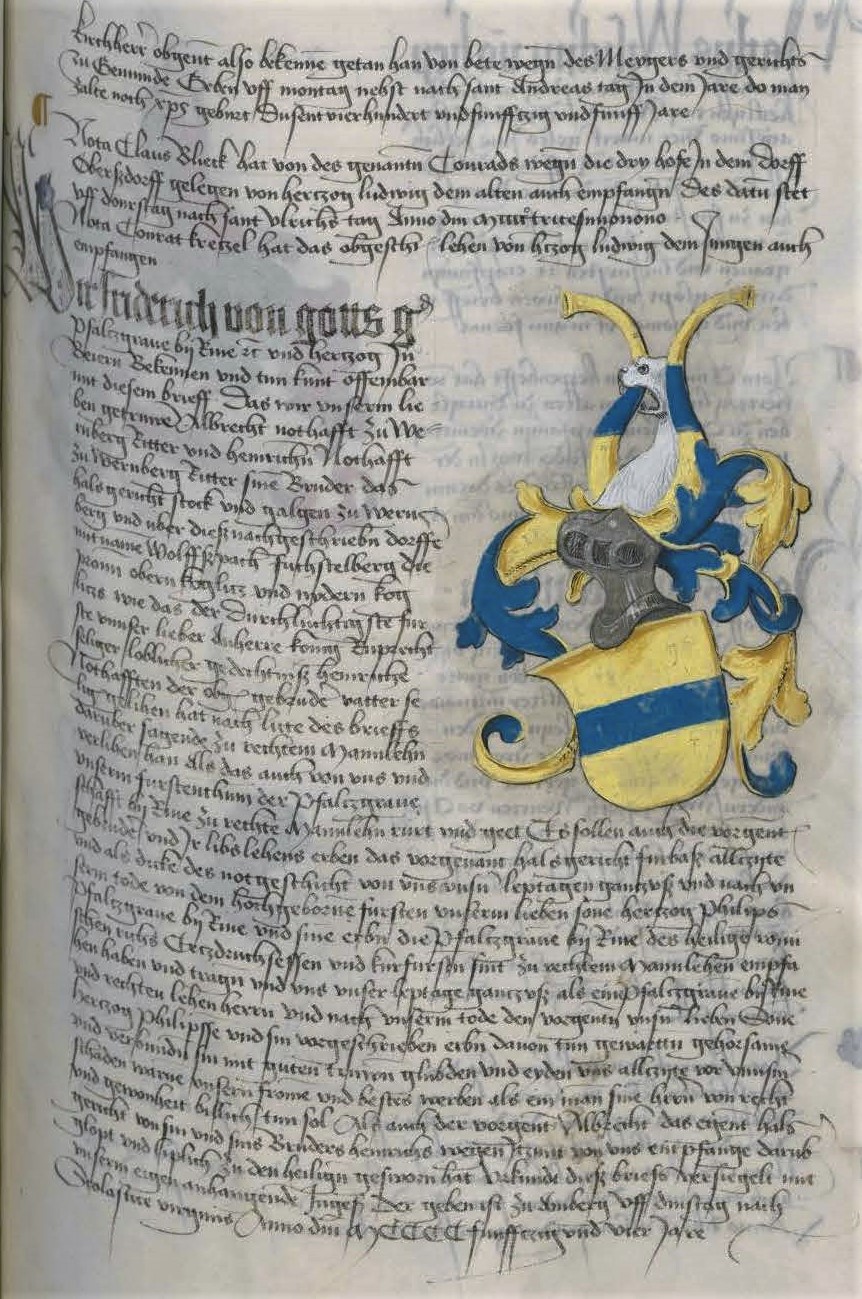
Earlier versions of this page attributed two Württemberg documents of 1366 and 1368 to Johann IV Nothaft of Wernberg. However, the 1368 record identifies the man as Hofmeister to Count Eberhard II of Württemberg. Historical research associates that official with the Swabian Nothaft milieu, making the attribution to ‘our’ Johann IV of Wernberg improbable. Accordingly we have removed the 1368 document but we have retained the 1366 document (shown below) a that appears to refer to ‘our’ Johann’, ie of Wernberg. A few documents exist which contain Johann’s signature, otherwise there are no other records that we have been able to locate, so far.
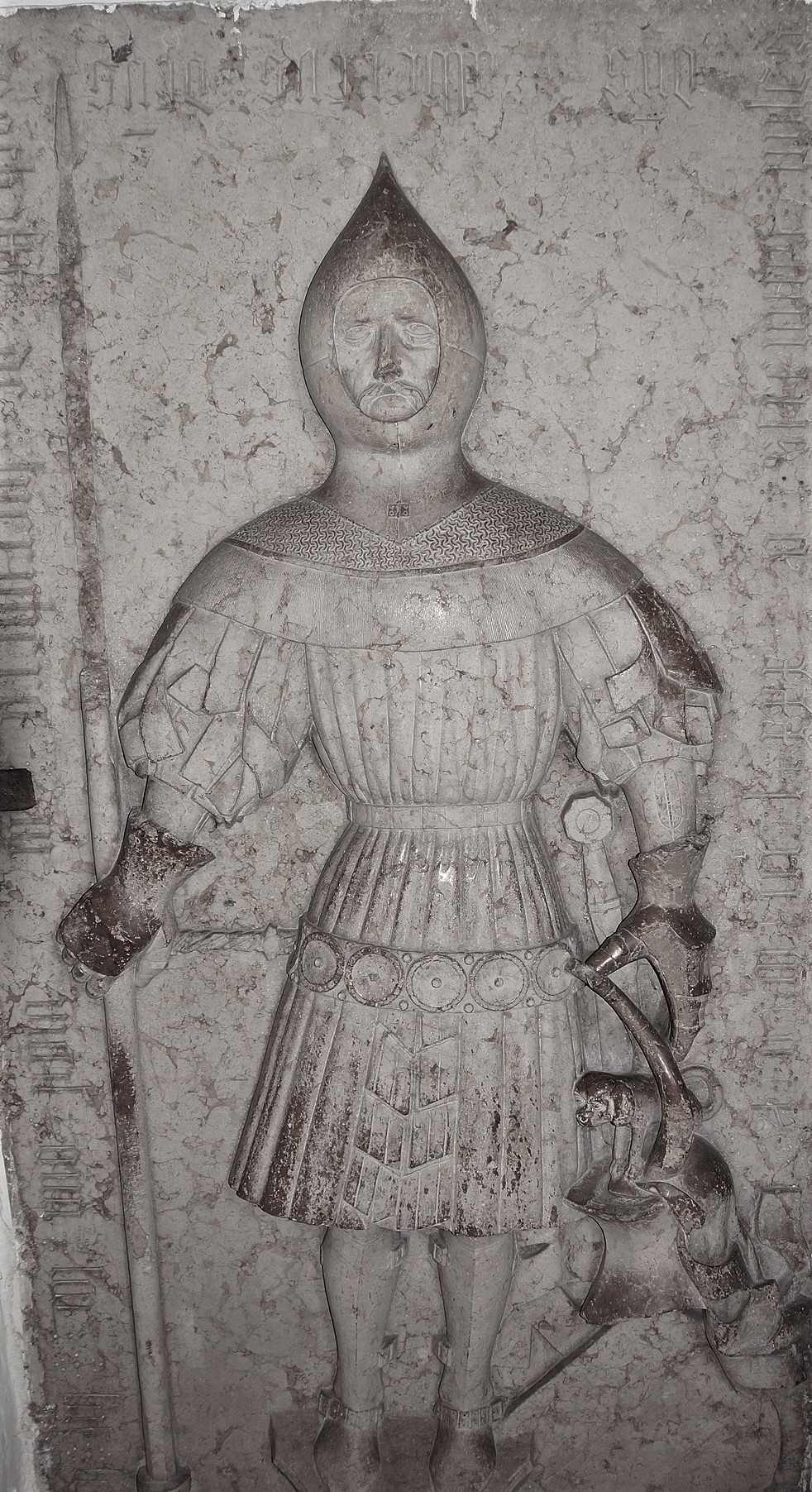
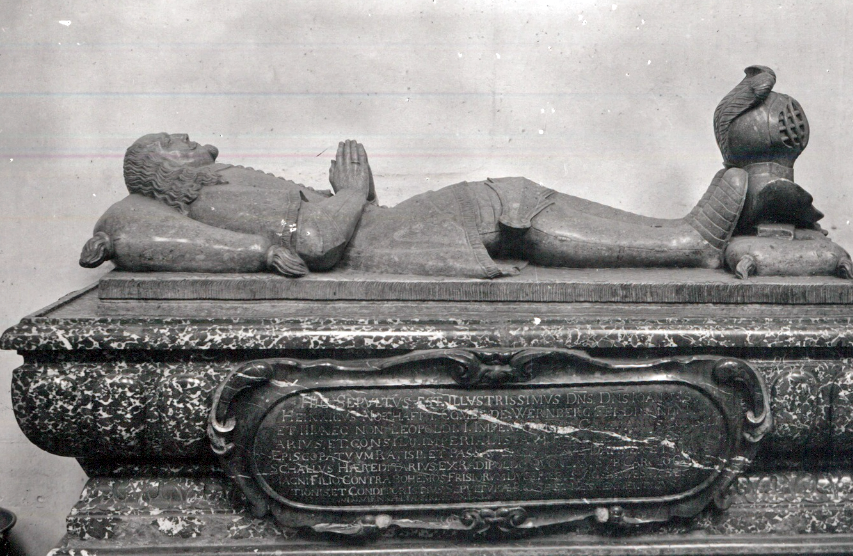
On the north wall of the chancel at St. Emmeram, Oberkolblitz, is a tomb cover plate for the imperial forest master Albrecht Nothaft von Wernberg (brother of Johann von Nothaft). It shows in a high relief, the deceased as a knight in full armour, equipped with a bascinet without a visor, a ring armor collar over a cloak with bag sleeves cut open, as well as a low-slung dupsing, the right hand is on the shaft of a lance and the left hand on the hilt of a sword. This work is described as: “a major work of the sepulchral culture at the beginning of the late Gothic period in the Upper Palatinate, which reveals the processing of stylistic influences from Prague court art”.
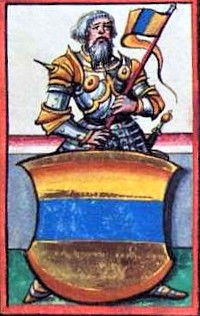
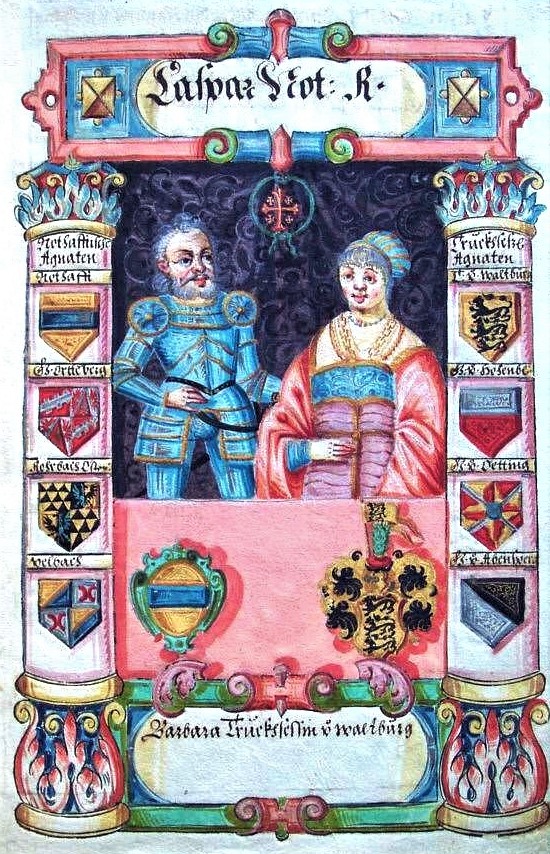
Below: Albrecht’s grandson, Heimeran III. Notthafft von Wernberg (+1483), in full armor and adorned with the Nothafft colors of gold and blue. Right, Caspar / Kaspar Nothafft von Wernberg (ca. 1450 – 1520) and his wife of Barbara von Waldburg zu Trauchburg another of Albrect’s descendants.
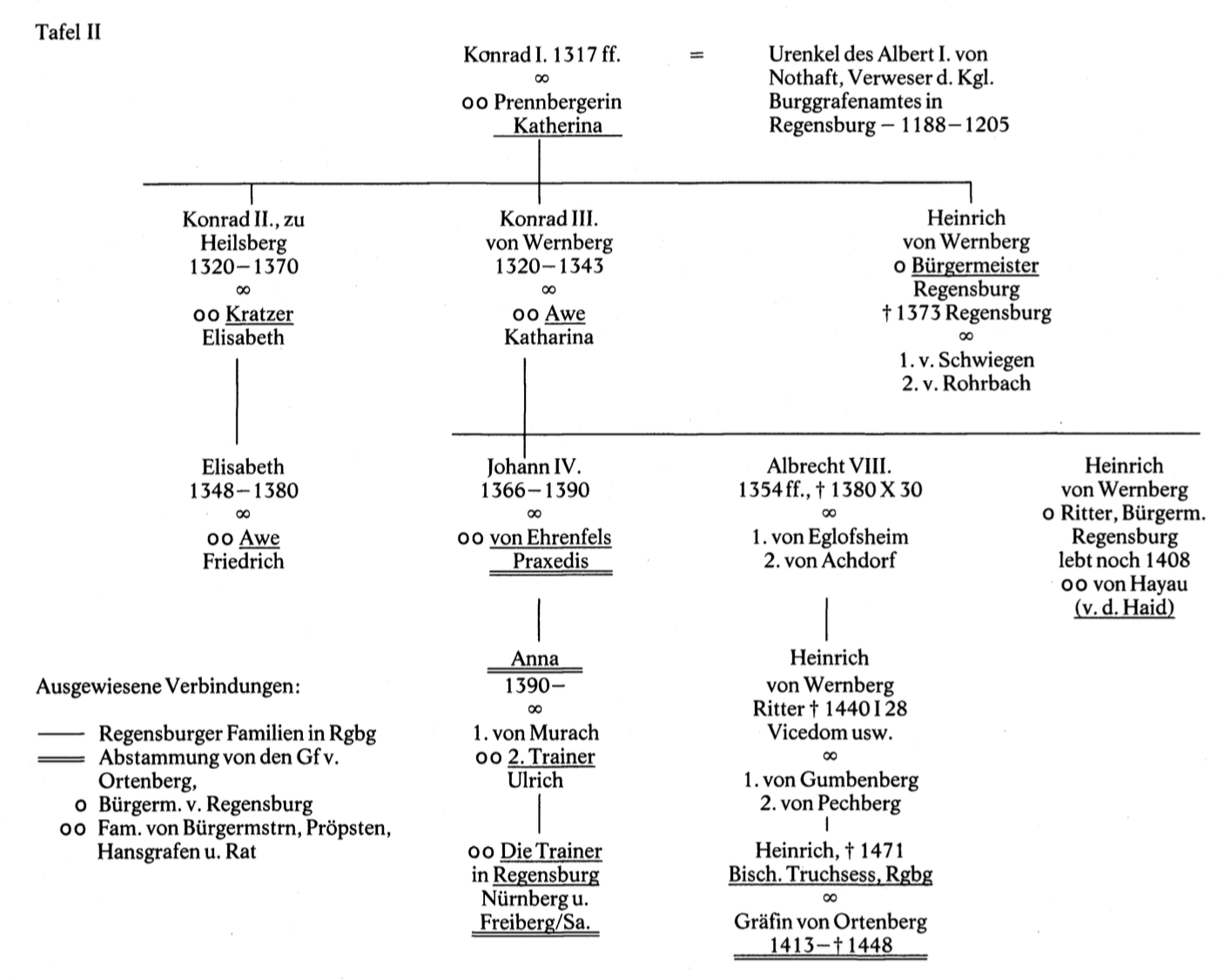
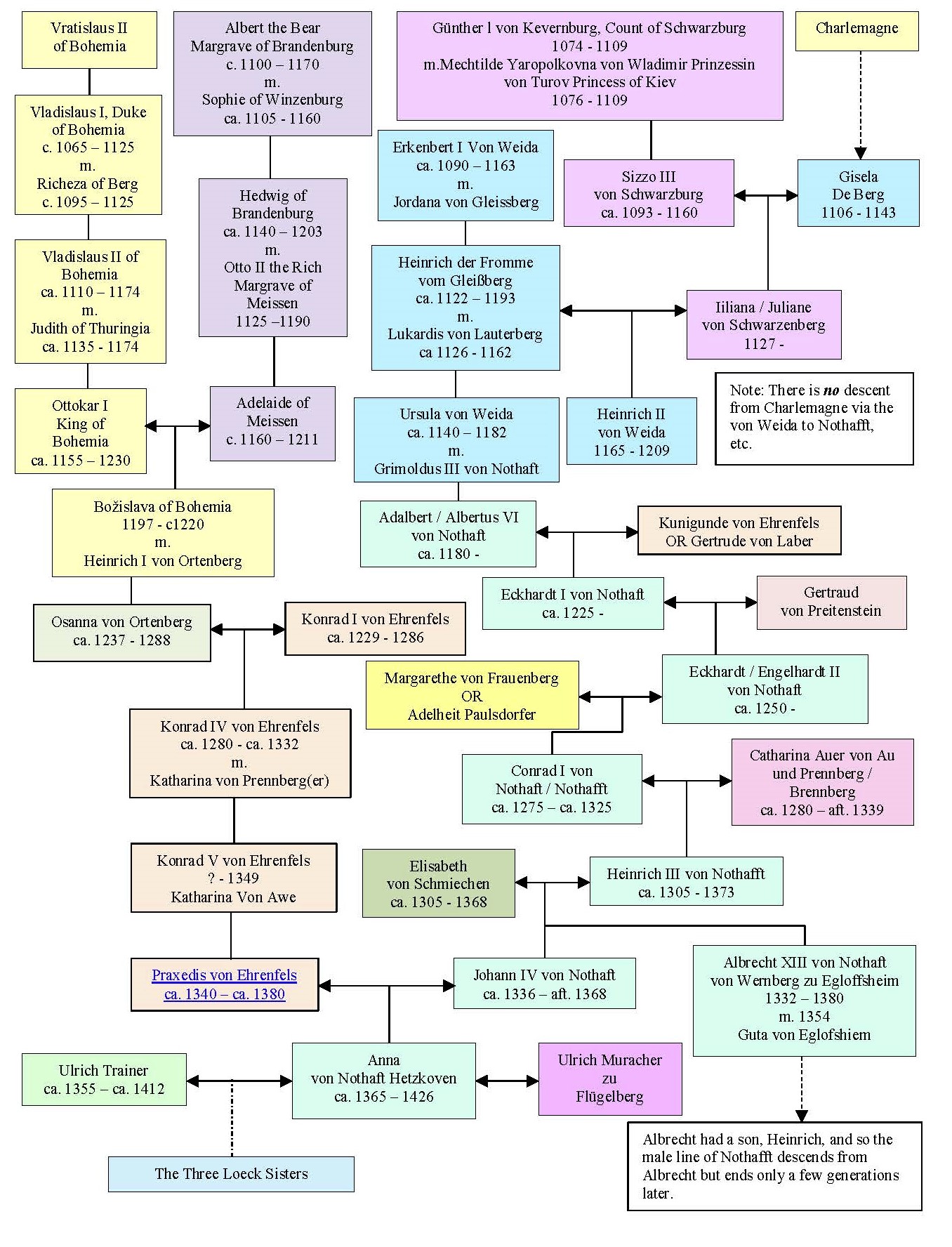
The chart below indicates that Johann von Nothaft married Praxedis von Ehrenfels The chart shows Konrad III von Wernberg / Nothafft as the father of Johann IV, Albrecht VIII, and Heinrich. Johann survived his brother Albrecht by almost a decade and there is some evidence that he was appointed guardian of his brother’s children. A six page PDF of a Nothaft genealogy can be found here. It is claimed that Praxedis is a descendant of Graf von Ortenberg. This is a result of Praxedis’ great grandmother being Osanna von Ortenberg who married Konrad von Ehrenfels.
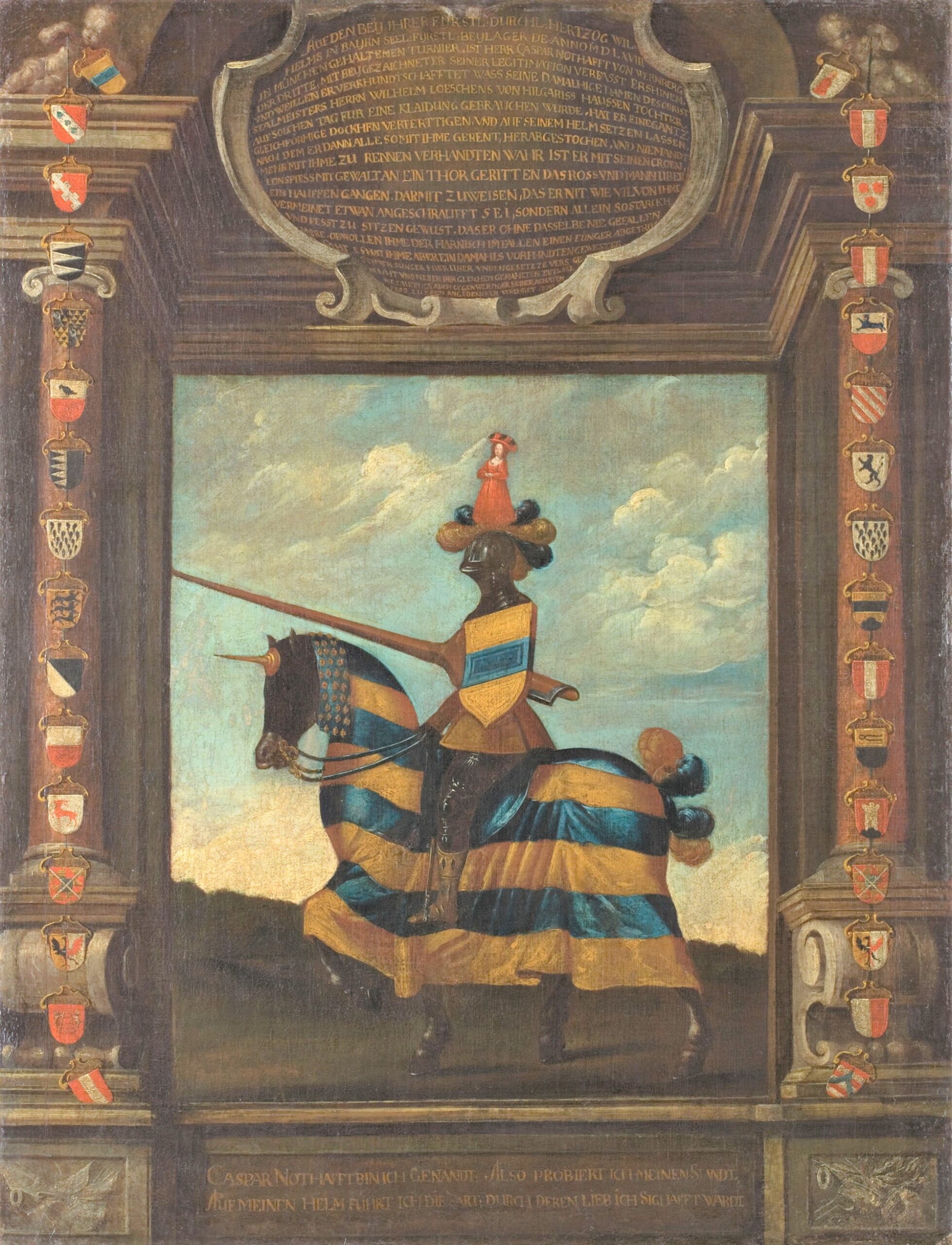
Below, the much celebrated jousting champion Casper Nothafft (a descendant of Albrecht’s) in his full regalia:
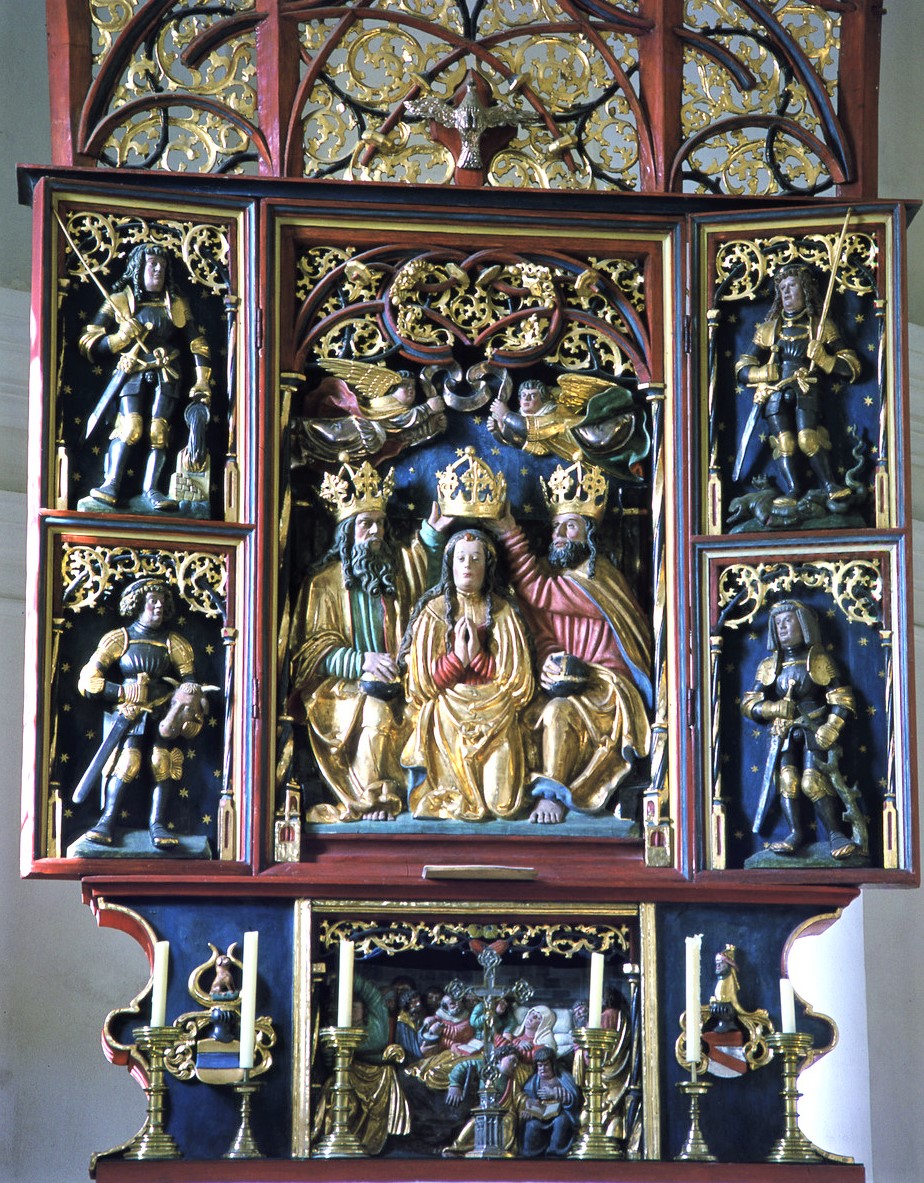
Below, an elaborate altar piece showing Mary being crowned surrounded by knights including a Nothaft indicated by the gold/blue/gold shield at the bottom left. Elements of the blue-and-gold Notthafft arms remain in the modern municipal arms of Runding, Blaibach, Weiding and Friedenfels.
Some of the families of the Nothafft wives:
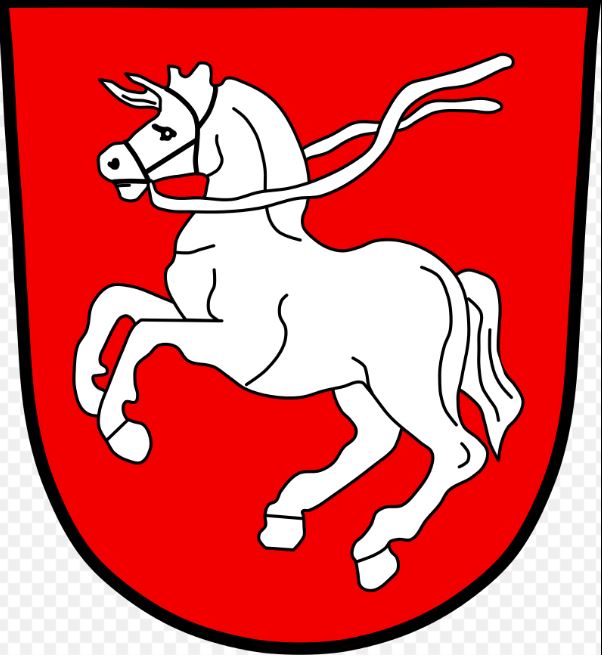
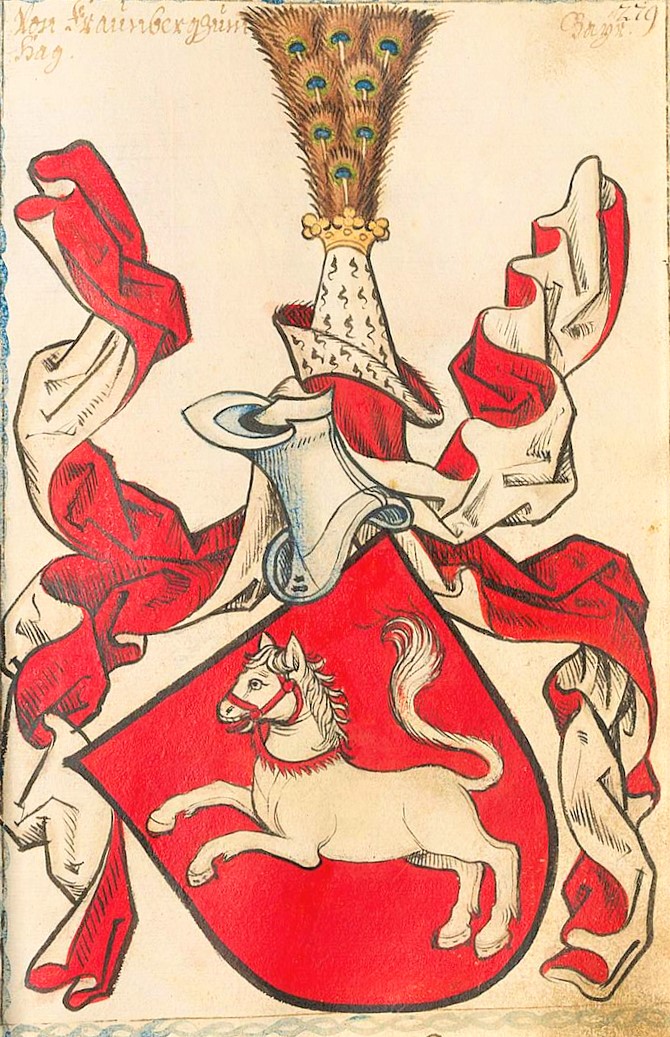
Margaretha Frauenberg who married Eckhard II von Nothaft was the daughter of Siegfried I von Frauenberg and Elisabeth Gurre zum Haag ( – 1279). Elisabeth was the great grandmother of Johann von Nothaft. Her father was Konrad Gurre von Haag (1175 – 1245). By marriage, the lords of Frauenberg became the lords of the County of Haag and they then incorporated the coat of arms of the Gurren’s (below left) into their own (right).
The Prennberg family which connects with the Nothaft upon the marriage of Catharina von Auer und Prennberg with Conrad I Nothaft has been covered on the ‘Antecedent Families‘ page.
The family tradition traces the origin of the family back to a Frisian prince, Radipold, who marched against Bohemia in Charlemagne’s army and thus came to the Nordgau (Bavaria). The family was first mentioned in 1140 with Rudolf vnd Eilhulf Nothaft and 1166 with Adalbertus Nothaft. However the fog of history makes such a claim unsupported by any historical evidence and it is safer to claim the beginnings of the family to around 1170. (see the Wikipedia entry for this family).
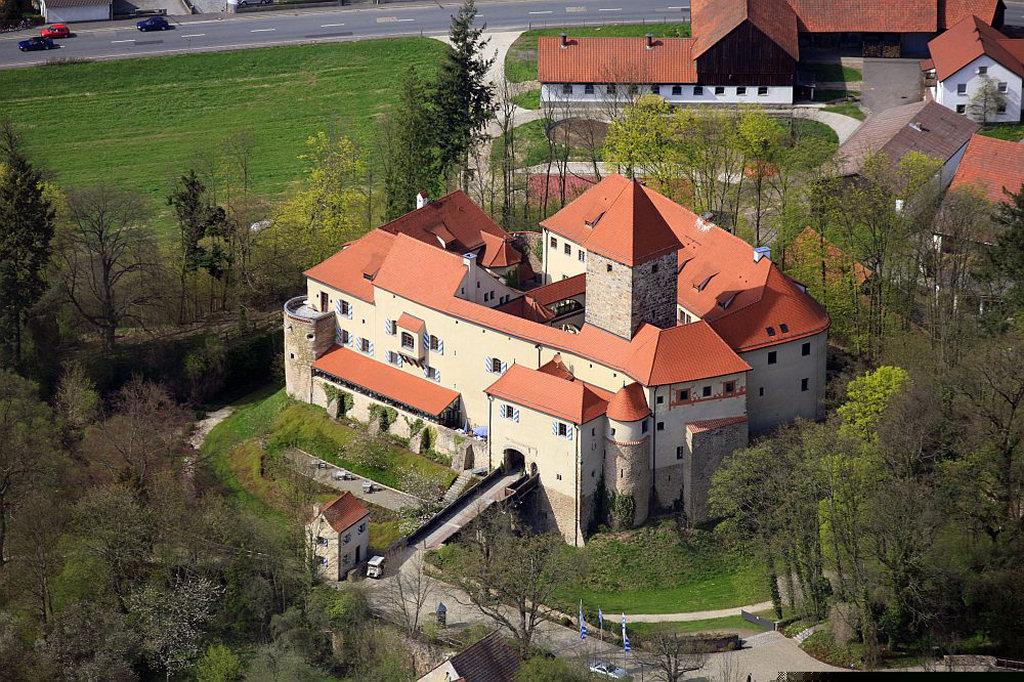
Some notes on the Castle of Wernberg:
1280 Burg Wernberg being first mentioned in the records. The landgraves of Leuchtenberg transfer ownership of the fortress and the surrounding lands to Konrad of Paulsdorf.
1281 Konrad signs over the ownership rights to his son–in-law, Heinrich Nothaft of Wildstein who henceforth adopted the title “of Wernberg” (after the eponymous village situated at the foot of the castle mount).
1284 For a brief period, Burgrave Frederik of Nuremberg becomes the owner of the premises. After which the castle returns to the Nothaft family.
1367 March 9 marks an important date in the castle’s history: Heinrich Nothaft voluntarily became a vassal of the Bohemian Crown and was allowed to keep the property rights to the castle. Charles IV, Holy Roman Emperor, and King of Bohemia, becomes the protector of Wernberg.
1366 November 30. Heinrich and Egid Paulsdorfer to the Tennesberg, Friedrich Zenger of the Siegenstein and Jordlein Zenger of Fronhof vouch for Heinrich Nothaft von Wernberg and his sons Albrecht, Hans and Heinrich against his wife Elisabeth. -Nothaft. Family-Arch. Ratio d. hist. Ver. f. Oberpf. Jhg. VII p. 286. l85
1368 May 2. Heinrich IV. Paulsdorfer vom Tennesberg and Niklas Engelhauser, Judge zu Leutenberg, perform for Heinrich Nothaft von Wernberg and Elsbeth, his wife, for Albrecht Nothaft to Eglofsheim and Hans [Johann] Nothaft for the two fiefs, which they confer on Konrad dem Ortenberger sold to Diepronn. – Nothaft. Family-Arch. L88.
1381 Karl Paulsdorfer to Tennesberg and Hans [Johann] Nothaft of Wernberg as representatives of the children of Albrecht Nothaft sell to King Wenceslaus of Bohemia for a sum of money the house Neuen-Eglofsheim.
1381 (November 29) Hans [Johann] and Beatrix [Praxedis] Nothaft sell half of the premises to their nephews Heinrich, Albert, and Hans.
15TH CENTURY
1401 Heinrich Nothaft (now also known under his cognomen “The Rich”) commissions a chapel to be erected on the premises. The building, dedicated to St George, is consecrated on October 16.
1406/7 (August 23) Heinrich Nothaft of Wernberg (judge at Nabburg District court from 1397 to 1434) obtains the ius gladii (the right to sentence convicted felons to death) from King Ruprecht I.
1430 The Hussite Wars reach the Oberpfalz. The Nothard (Nothaft) family does their part in crushing the rebellion three years later.
16TH CENTURY
1509 Death of Heinrich III of Nothaft. Jörg Wispeck. After Heinrich III’s death, Georg, Kaspar, Heinrich, Hans and Bernhard Nothaft collectively sold Wernberg to Georg/Jörg Wispeck of Velburg. Burg Wernberg history.
1530 Wispeck’s son, Adam, sells the castle to the Landgraves of Leuchtenberg.
1560 Landgrave Ludwig Heinrich bestows a coat of arms on Burg Wernberg.
17TH CENTURY
1646 The death of Max Adam of Leuchtenberg on November 1 marks the end of the Leuchtenberg lineage. Burg Wernberg and Wernberg town return to the Bohemian Crown. Count Khevenhüller restores the run-down premises, subsequently selling them to Maximilian, Duke of Bavaria.
1650 Emperor Joseph I, acting as king of Bohemia, drew in the fief and granted it to Prince Matthias Leopold von Lamberg. Wernberg returned to the Wittelsbachs in 1714. See: Castle chronology.
The Wernberg’s hotel closed in 2019. Since 2020 the restored castle has housed a private clinic for psychosomatic medicine and psychotherapy. Official Vincera Burg Wernberg site.