
Georg Adam Struve was the son of Barthold and Anna Margarethe (Brunner) Struve. He was born at Magdeburg in Saxony on 26th September 1619[1]. Georg Adam was the direct ancestor of the Three Loeck Sisters, being their Nth great grandfather. Among his siblings were:
- Anna Margaretha Struve (1624 – 1679)
- Anna Maria Struve (1634 -1666)
- Johann August Struve (1637 – 1704)
- Juliane Struve (1621 – 1679)
Because his life is well documented elsewhere we give here only the barest outline of his life.
He married twice. His first marriage was to Anne Marie Richter, the daughter of Christopher Philipp Richter. After she died in 1662, conscious that his professional duties incapacitated him from paying the necessary attention to the education of his children, Struve, began to look about for a second. His choice fell upon Susanna Berlich, daughter of a distinguished lawyer resident in Dresden – Burchard Berlich. They were married on 30th August 1663 at Dresden and she died on 22nd January 1699 (survived him by six years). She brought him seventeen children, of whom four sons and one daughter survived. This website follows the descent of those from this second marriage and in particular Friedrich Gottlieb Struve, our direct ancestor. Of the seventeen children Georg Adam and Susanna (Berlich) Struve had, we only trace the following:
- Burchard Gotthelf Struve
- Margaretha Barbara Struve
- Friedrich (Georg) Wilhelm Struve
- Friedrich Gottlieb Struve
- Georg Gottlob Struve (1652 – 1700)
- Ernst Gotthold Struve (1679 – 1759)
Georg Adam received instruction in the first elements of Latin, and other branches of knowledge, at the Lyceum of Magdeburg, until the age of eleven. In 1630 he was sent to Hennebergisches – the Gymnasium / High School at Schleusiugen – where he remained till 1636. His principal tutor was Samuel Reyher (left), a man of great reputation as a teacher, who, besides grounding him thoroughly in Greek and Latin, imparted to him some notions in philosophy and belles-lettres.

During the Thirty Years War, his family had suffered much following the destruction of Magdeburg by Tilly’s army, and in particular the devastation of the district in which their property lay. This resulted in an unsettled life for several years, with the family moving from town to town until the storm of war having drifted into other provinces, they ventured back again to take up residence at Magdeburg. They had not seen Georg throughout this time which lasted some six years.

Not long after their return, Georg Adam arrived at the house of his parents a few days sooner than he was expected. Six years had so completely changed his appearance, that he was received as a stranger both by his parents and sisters, who did not recognise him until he declared himself.
In June 1636, Struve entered the University of Jena. The taste which he had acquired for literature and science, under his schoolmaster Rehyer, prompted him, although the law was his professional study, to devote a good deal of time to philosophy classes.


All these pursuits however were carried on in subordination to his legal studies. He attended the lectures of the leading jurists of the day: Peter Dieterich, Erasmus Ungebauer, and Ortholph Fomann. The last-mentioned was a relation of Struve’s mother, as the chart below indicates.
Struve had no relish for the wild merriment which then, even more than in modern times (1856), was a characteristic of German students. He seems to have been of a quiet and even timid disposition, for a fright that he got from some soldiers, when a marauding party plundered Jena, soon after his arrival at the university, impaired his psychological health for several years. His irreproachable conduct prepossessed the professors in his favour; and the distinguished appearance he made in a disputation which he maintained, in the philosophical faculty, on his thesis De victoria et clade. II. De ducibus et comitibus imperii romano-germanici …, raised great expectations of his future eminence.


He quitted Jena on 11th September 1639, and his public certificate from the heads of the University was more than usually flattering. He remained upwards of a year in his father’s house for the purpose of re-establishing his health, which had not yet recovered from the effects of the shock above alluded to.


In the year 1641 he entered himself at the University of Helmstedt, where he remained till April 1645. He studied under a relative, Conrad Horn, who exercised him, along with his other pupils, unremittingly in private disputations.
In January 1642, Struve maintained a public disputation in the law faculty, on a thesis De Damnis, illis pracique qu;u ex dolo, culpa… And in July 1643, he maintained one in the philosophical faculty, on a thesis De Ducibus et Comitibus Imperii Gormamci. In February 1645, he again supported a juridical thesis De Viudieta Privata, and having been admitted to the preliminary examinations, received his license as candidate for the degree of Doctor of Laws.


Two months thereafter, before he had completed his twenty-sixth year, he was appointed by Augustus, duke and archbishop of Magdeburg, assessor to the magistrates of Halle, an office which he retained not quite a year and a half
In the month of February 1646 he received, as a matter of course, the title of Doctor; and in the December following he was called to fill the chair of law at the University of Jena, left vacant by the death of Godefridus Fibigius.
In 1650 and again in 1656 he was appointed Rector of the University of Jena. After his allotted time was up he was succeeded by Johann Theodore Schenck (1619-1671) whose sister Regina (* 17 March 1608 in Zwickau; † 8 May 1655 in Jena), had married Struve’s great uncle Jacob Fomann on 3rd March 1628. Johann Schenck and Regina (Schenck) Fomann were the children of Eucharius (Euseubius) Schenck (see chart).

In 1650 Georg Adam inherited the ‘title’ to Wantzleben from his father which was referred to in the title of the book: Dirigente Dn. Georgio Adamo Struven Haereditario in Wantzleben und Wenigen Jehna …


Georg Adam was admitted an assessor to the magistracy in January 1647; and in June 1648 an assessor to the high court of the circle of Saxony. He continued in the discharge of his judicial and academic duties till 1667. His opinions were in great demand both in controversies relating to public and those relating to private rights. The town of Brunswick, being at that time involved in a dispute regarding its privileges with the duke, requested Struve to undertake the management of their legal business; and he, having obtained the consent of the patrons of the university, was appointed, on the 20th March 1661, counsel in ordinary to the town of Brunswick for three years, with an annual salary of 300 dollars, becoming bound to advise its magistrates in writing whenever called upon, and, if necessary, to visit the town four times in the year.


The duke and town having settled their dispute by a compromise, this connection with Brunswick was dissolved in December 1663. At first Struve lectured upon the ‘Institutes,’ a duty devolving upon the youngest professor. As his seniors died off, he was called in succession to lecture upon the ‘ Pandects,’ the’ Code,’ and ultimately upon feudal law.
1663 was also the year in which he married Susanna Berlich and to help mark the occaison, a single broadsheet was issued under the title: Applausus Votivus Quo Viro … Dn. Georgio Adamo Struven hereditario in Uhlstedt …

Many of his works were co-authored or in some way associated with family members. For example Dissertatio Canonica de Jure Precum … included his uncle Georg Adam Brunner:

Drawing on his own experience Georg Adam had a high opinion of the benefit to be derived from disputations, and so he encouraged his pupils to engage in them frequently among themselves under his guidance; and in course of time the idea suggested itself to him of making the young men maintain in succession disputations on all the leading doctrines of the branch of law he might be lecturing upon at the time. From a series of theses impugned and defended in this manner arose his: Syntagma Juris Feudalis, first published in 1653, and his Syntagma Juris Civilis, first published in 1658.

In 1667 he was unexpectedly appointed a privy councilor to the duke of Weimar, and transferred himself and his family to the seat of government in the month of December.
His discharge of the duties of this office gave so much satisfaction, that when the line of Saxe-Altenburg became extinct in 1672, and doubts were entertained whether the line of Gotha or Weimar had the nearest claim to the succession, he was elected as the ablest person to advocate the cause of his master. In the conduct of this delicate business, he had the merit or good fortune to give entire satisfaction, both to the party for whose interest he acted, and that to which he was opposed. When the territories of the house of Weimar were divided between the brothers, he remained in the service of the Duke of Weimar. Notwithstanding the load of public business that devolved upon him during this period of his life, he contrived to find some time for the literature of his profession.


He published in 1669 answers to objections which had been urged against some of the doctrines maintained in his Syntagma Juris Civilis, a work which had been completed before he left Jena. In 1668 he published Jus Sacrum Justinianeum. He often worked with members of his immediate family and more distantly related ones such as with Adam Gottlob Berlich on – Decisionum Canonicarum & Practicarum De Conventionibus Et Contractibus … [1676].


He compiled his remarks on the Immo of Gothofredus, which his son Burkhard Gotthelf published at Frankfurt after his death.
The Ordinarius of the Judicial College of Jena died in 1674; and notwithstanding the active competition of the most distinguished German jurist for so distinguished and lucrative employment, Struve was selected by the patrons of the university as the best qualified for the office, along with which the professorship of canon law was then uniformly held.


On the 28th July he made with his family a sort of triumphal entry into Jena; for the citizens and the members of the university met him in procession at some distance from the town. The important offices to which he had been appointed he continued to fill till his death, although the active discharge of their duties was interrupted for a time by the affairs of the regency of Jena.

ab ipso olim in Academia Ienensi …
On the death of Duke Bernard (1638 – 1678), to whose share the duchy of Jena had fallen at the partition of the Weimar territories, his son Johann Wilhelm (1675-1690), a minor, succeeded. His uncle Johann Ernst of Weimar (1664 –1707) was guardian, but it was deemed expedient that a permanent council of regency should sit at Jena. Struve was appointed president of this body at the end of August 1680.


In virtue of this appointment, the whole burden and responsibility of the general executive government of the territory, the discharge of the consistorial business, and the management of the finances, fell upon his shoulders. He was obliged to relinquish to another the discharge of his professorial duties, reserving however his appellate jurisdiction as ordinarius. So many cares naturally distracted his attention from his own private concerns, which were considerably dilapidated in consequence of his elevation.

His pre-eminent position too exposed him to much malevolence; but he laboured indefatigably, and gave satisfaction both to the Duke of Weimar, and to the Duke of Eisenach who were the guardians of Johann Wilhelm. However, the young Duke of Jena died towards the close of 1690, and not long after a partition was agreed to by the lines of Weimar and Eisenach, and the council of regency being dissolved in consequence, Struve returned to his academic positions.
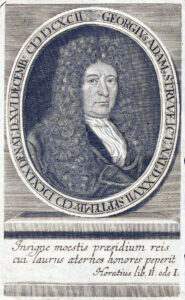
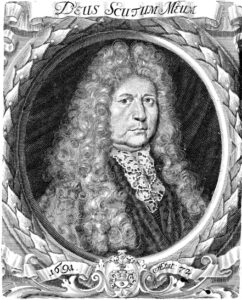
In 1696 Johann Wilhelm Struve gathered some of his brothers legal treaties together under the title: Georg Adam Struvens Vornehmen ICti, Iuris-Prudenz, Oder Verfassung der Landüblichen Sächs .. which included a portrait of Georg Adam and his protégé the young Duke who had died six years earlier.


His life at Jena, both before and after this interruption, though busy was a uniform one. As privy councilor he attended every consultation to which he was summoned by the dukes his masters. As Ordinarius (Chairman) he presided both in the ordinary and appellate tribunals of Jena.
In 1669 a book of Georg Adam Struve’s writings, along with those of Joachim Schnobel’s were gathered and edited by Adrian Beier who published them together under the title: Harmonia Struvio-Grotio-Schnobeliana, Sive Celeberrimi Icti Dn. Joachimi Schnobelii … Dissertationes XXV. ad Pandectas Perpetuis ad Syntagma Iuris Civilis Illustris Icti Dn. Georg. Adam. Struvii …


He prepared opinions in reply to the cases addressed by numerous applicants either to the Judicial College of Jena or to himself individually. In addition to these occupations, he faithfully expounded to his pupils the doctrines of canonical law as then received in the courts of the Protestant states of Germany.
Georg Adam often wrote works with Johann Christfried Sagittarius such as: Bona Verba, Quibus Summos in Philosophia Honores, Magnifico Rectore … , [1650].


The chief ambition of his later life was to try to bring the canonical law of Protestant Germany into a better and more systematic form. With that in mind he projected various works; but on account of their extent, and the interruptions he experienced, only fragments of them were completed. A projected Jurisprudentia Canonica, after the model of his own Jurisprudentia Romano Germanics, remained a mere project.
The book Disputatio Iuridica De Accrescente Legato contains not only Georg Adam Struve on the title page but various members of the GOTTER family.


Of a complete Commentary on the Five Books of the Decretals, only that which relates to the fifth book, Observationes Criminales de Delictis (shown left), was published at Jena in 1691. His son Friedrich Gottlieb Struve acted as editor.


He found time, amid all his labours, to compile a system of the common law of the Empire in the German language, a work which was undertaken at the request of Duke Ernest of Gotha, and published in 1689. Despite his many children, Georg Adam Struve made a considerable fortune by selling his legal books, which had been in use as standard works for almost a hundred years. In addition to his father’s estate in Wansleben, he also owned goods in Uhlstadt and Wenigenjena. He was probably one of the first academics to realize the benefits of assigning his own works to his students.
Georg Adam died on 15th December 1692. There are not the large number of funeral sermon books published as one would expect given his life and status. Indeed, to date only three have been located: Programma In Funere Illustri Atque Excellentissimi Viri Georgii Adami Struwii Hereditarii in Wanzleben & Wenigen-Iena … academiae senioris d. XVI. Decembr. A. M. DC XCII Placide Defuncti P. P. [left]
And, Die erfüllte Prophezeihung Der Jenaischen Wasserfluth, Welche Bey Hochansehnlicher Sepultur Des … Herr George Adam Struvens … Weitberühmten JCti … Als Seine Magnificenz den 16. Decembr… [right]


Another funeral book was: Immortalis Famae ICto Georg Adamo Struvio …


His son remarks that his energy and love of life seemed materially to abate after the shock he received by the death of the young duke. He continued however without intermission the arduous duties of his office, and was seized in court with the illness which carried him to his end in less than twenty-four hours. It was a maxim which he was fond of repeating, that “the Ordinarius of Jena ought to die standing.”


The writings of Georg Adam Struve indicate a mind which, as far as it could see, saw distinctly and correctly. He belonged, notwithstanding his studies in philosophy and history, rather to the race of jurists that preceded him, than to the more accomplished race which succeeded him. His historical erudition is very deficient in critical discrimination; and he labours painfully to torture the doctrines of law into the formulae of scholastic logic.
A good example of family members associated together with a work is Exercitium juris academicum de conclusione in causa praeside Georgio Adamo Struven, jcto, publicae indagine subjicit which includes: Ernest Ludwig Avemann, Hiob Ludolph, and Johann Jacob Avianus.


His most important work, Jurisprudentia Romano-Germanica forensi …. , was published 31 times between 1670 and 1771 – in part with commentary by other well-known lawyers. Among these were Luder Mencke’s Additiones Ad Georgii Adami Strvvii JCti Jvris Prvdentiam Romano-Germanico-Forensem: Cvm Indice. For a period of more than 100 years, the work was a standard work for both students and legal teachers as well as for judges and lawyers.


It was as a practical lawyer that he distinguished himself; a character for which perhaps even the limited range of his mental vision peculiarly qualified him; but towards the formation of which his robust yet tranquil constitution both of mind and body, his clearness of apprehension, self-possession, and moral courage, but above all his high and pure sense of moral rectitude, were invaluable ingredients. His influence in the development of German jurisprudence was exercised as presiding judge in an important appellate tribunal; as a consulting lawyer whose opinions were highly valued throughout all Germany; and as a judicious former of the minds of youth. He worked more through the jurists he trained, than by his own works. Georg Adam Struve was one of those robust, quiet, powerful natures which are of more importance in society than nine-tenths of the more glaring personages who engross the admiration of the multitude.
Some of his works were edited and reissued after his death. In 1733 for example Luder Mencke edited Additiones Ad Georgii Adami Struvii Jcti, Juris Prudentiam Romano-Germanicam

[1] Much of the above is taken almost directly from: The Penny Cyclopædia of the Society for the Diffusion of …, Volumes 23-24.
ADAM GOTTLIEB STRUVE (1664 – 1670) son of Georg Adam Struve and Susannah Berlich. He died at the age of five. A funeral book was published extending over one hundred pages and including a poem written by his mother which for the time was unusual. Schrift-Gründliche Ursachen Der Gerechten Früh-Zeitiges tödtliches Hintritts. Aus dem Buche der Weißheit am 4. Cap. v. 7.-14.; Bey … Leich-Begängniß Des … Georg Adam Struvens …We learn from the title that their “beloved son” Adam Gottlieb died on 27th October of the year 1670 and then on the 8th of November he was laid to rest …


In 1674 Georg Adam and Susannah experienced the birth of a still born daughter named Sophia Caritas who died on 28th April and was buried on 1st May and whose funeral sermon was published under the title: Des großen Gottes treue Vorsorge …


SUSANNE STRUVE 1680 – 1680
A daughter of Georg Adam and Susanna (Berlich) Struve whose brief existence (3 days) was noted in a funeral verse oration titled:
Den abgefallenen Apffel wolten radito Sinnbild des … : [Trauerschrift auf Susanne, Tochter von Georg Adam Struve, *6. Mai 1680 +9. Mai 1680] The fallen apple wanted as a symbol of …: [Funeral inscription on Susanne, daughter of Georg Adam Struve, * 6. May 1680 +9. May 1680]


